
How New Orleans Arrests Work
New Orleans and Orleans Parish cover the exact same ground. That quirk simplifies your search. The state locality page lists the city as the parish's only municipality. So there is no separate city jail system to hunt through. NOPD and other agencies make arrests all over town. Yet local custody funnels through one door: Central Lockup, where people are booked into the sheriff's system at the Orleans Justice Center.
That single pathway tells you who holds each piece of paper. NOPD keeps the incident report and its item number. The sheriff's office holds the booking entry, booking number, and current custody status. Criminal District Court keeps whatever happens to the case after that. The Census counted 362,701 residents in 2024. Algiers, Gentilly, and the French Quarter are neighborhoods, not cities with their own record custodians.
Where New Orleans Busted Mugshots Appear
No single official gallery collects every New Orleans booking photo. Each public source has one custodian and one narrow purpose. Check image availability on the individual OPSO result. Or ask through a tightly written records request.
| Channel | Photo? | Status | Best use |
|---|---|---|---|
| OPSO Detainee Search | May vary by result | Official | Current, recent, and archived parish bookings |
| Orleans LA VINE | No gallery observed | Official | Independent custody-status check |
| NOPD Major Offense Logs | Generally no | Official | Major city events, not a full arrest list |
| NOPD records portal | Request dependent | Official | Incident reports and specific investigation photos |
| Local news and third-party indexes | Selective or uncertain | Unofficial | Research leads that must be checked against official records |
Unofficial sites carry real risks. They can copy stale data, skip a later case outcome, or post an image with no hint of where it came from. Search the official channels first. Treat no commercial page as proof that someone is in custody right now.
Finding Who Was Busted
A solid New Orleans lookup moves in one direction. Sheriff custody comes first. Police context second. Court outcome last. Write down the date and time you searched, because a transfer, a release, or a portal refresh can shift what appears on screen.
- Open the official OPSO Detainee Search and try the Recent control for a new booking.
- Search by last name, first name, or booking number, then repeat with archive records included.
- Check Orleans LA VINE if current custody is unclear or notification information is needed.
- Use the NOPD item number, Major Offense Log, or electronic report data to identify the city event.
- Follow the case in Criminal District Court or the proper municipal court to learn the disposition.
The Orleans Parish booking guide digs deeper into the sheriff roster and its recent-booking filters. Released people drop off a current-custody roster fast. Underneath, the archived booking entry, police report, or court case may still exist.
Note: A blank result can mean unfinished processing, a different legal name, a transfer, a release, restricted data, or a temporary portal glitch.
New Orleans Busted Event Timeline
Don't confuse the NOPD Major Offense Log with the OPSO custody search. They aren't rival copies of one database. The log covers major events across a rolling 24-hour window, roughly 7:00 a.m. to 7:00 a.m. NOPD itself warns the entries can be raw, incomplete, unconfirmed, untimely, or out of order.
Custody records arrive later in the process. Picture the chain: police event, verified arrest, transport to Central Lockup, OPSO booking, roster update, court case. A logged event can appear before any booking is finished. Some logged events never produce a named arrest at all. A sheriff booking might even trace back to an agency or incident that particular NOPD log never captured.
When timing is unclear, run the official sheriff search twice. The Recent control suits a fresh booking. A name search with "Include Archive Records in Search" can surface an older entry that has left the current view. Note which setting produced your match, since a recent result, an archived result, and a current-custody result describe three different states and mixing them up will mislead you.
The official NOPD Major Offense Logs page shows how the city presents those rolling administrative records:
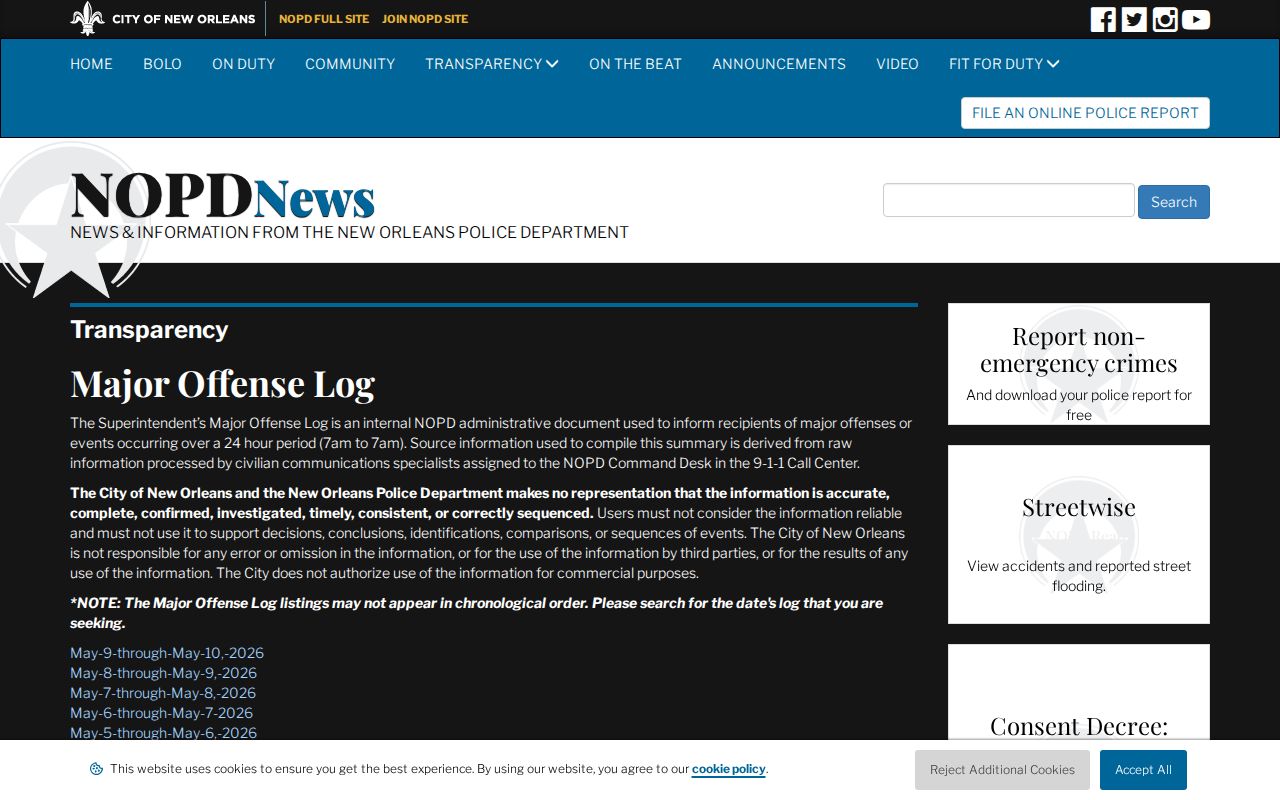
That interface helps with dates and event context. It is no substitute for a named OPSO custody search or the court record.
New Orleans Arrest Report Requests
Ask the agency that created the record. NOPD's Records and Identification Division handles releasable police and accident reports through its Public Records Section. The division also runs separate criminal-records, expungement, and subpoena functions. For a sheriff booking entry or a booking-photo question, OPSO is the custodian to contact.
1615 Poydras Street, Fifth Floor
New Orleans, LA 70112
Records: 504-658-5455
Non-emergency: 504-821-2222
Public hours: Monday through Friday, 9:00 a.m. to 2:45 p.m.
Begin at the official NOPD police-reports page. Include the item number if you have it. Add the incident date, location, subject's full name, involved unit, and the exact record you want. Fees are straightforward. An official offense report costs $25 for the first ten pages, then $1 per added page, and each official investigation-photo print runs $10. Form 26 promises 14 to 21 working days. One catch: its older address clashes with the current Poydras Street listing, so verify before you mail anything.
The official report page lays out the current request path. It also notes that Louisiana Public Records Law permits redaction or withholding in some cases:
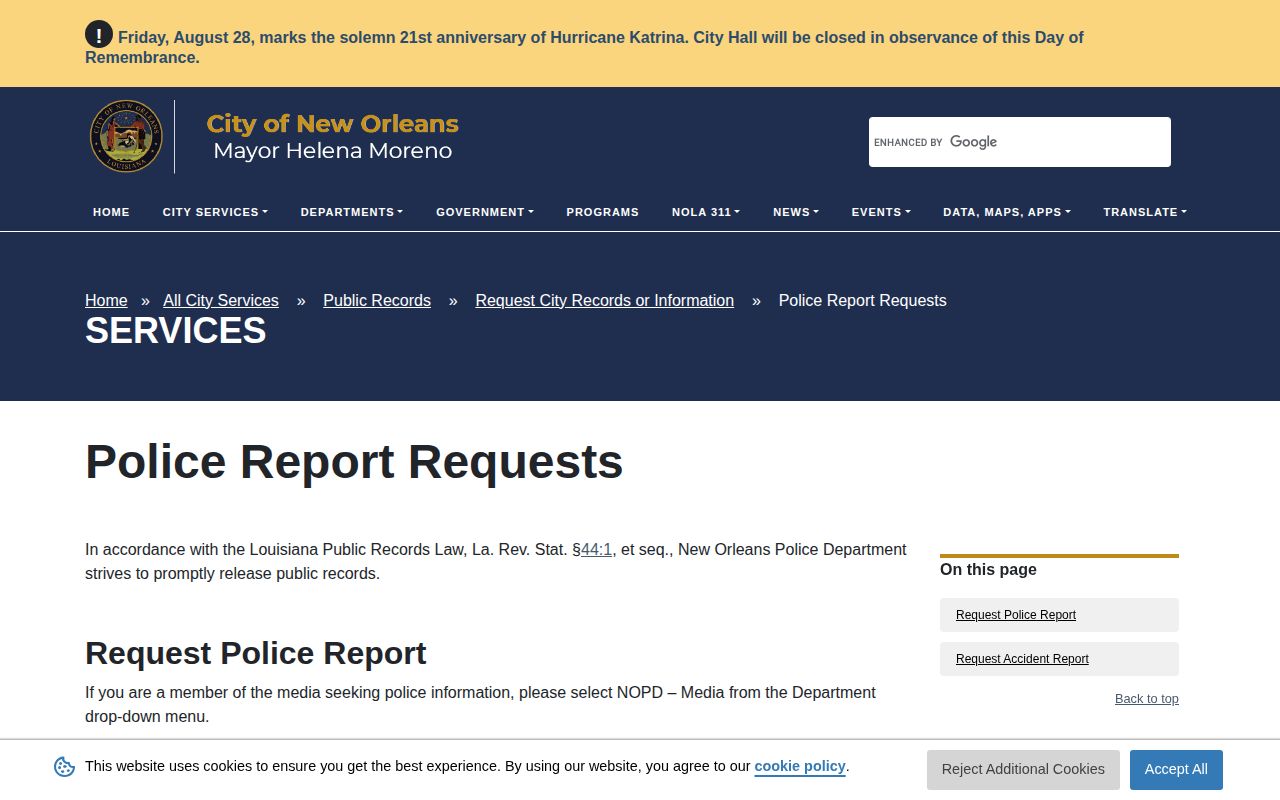
Skip the old saved form. Use the current NOPD records page instead, since agency addresses, instructions, and portal links change over time.
Busted Mugshot or Police Report?
One booking image barely scratches the surface of a New Orleans arrest. The NOPD's electronic police-report data can carry more. Expect an item number, a location, a signal, listed charges, and a few demographic fields. Those details help you tie an event to a request. The dataset gets corrected and supplemented over time. So it is not a booking table.
Go to OPSO first. Ask for the booking entry that Louisiana criminal procedure supports. Then ask on its own track whether a booking photograph exists and can be released. For the incident report or an official investigation photo, ask NOPD and cite the item number. Access to an initial report never opens the whole investigative file. Officials may withhold or redact sensitive material, juvenile content, confidential sources, undercover details, and anything tied to an active investigation.
Articles 228 and 229 draw a clear line. They cover the booking book, the summary, and the certified booking entry. They never promise that a photo appears on some public website. A smart request starts narrow: name, booking number, booking date, listed charges, bond details, arresting agency, and release or transfer status. Then ask whether OPSO holds a responsive photo and whether any legal limit blocks its release. That order still yields a solid official record even when no image is posted online.
What if there is no photo? Keep three things in separate mental folders: the booking entry, the police report, and the court docket. Each stays useful on its own, with or without a sheriff's image.
New Orleans Busted Mugshots in News
WDSU, Fox 8 WVUE, NOLA.com, and The Advocate jump on New Orleans crime as it happens. A big story may carry an NOPD, OPSO, investigator, or Crimestoppers image. None of that adds up to a full booking feed. Read captions and dates closely. A later sentencing piece sometimes recycles an old arrest photo.
Unofficial indexes float around too. Busted Newspaper, RecentlyBooked, Mugshots.com, and Arrests.org can be stale, patchy, or vague about whether Orleans photos even exist. RecentlyBooked states flatly that the parish does not supply mugshot images. Even so, cached item pages still show a generic "Booking photo" label. Do not read that label as any sign of official provenance.
Let official sources settle the question. Match the name and booking number in OPSO. Confirm the event with NOPD, and check the court for the outcome. The wider Orleans Parish Arrest News page breaks down how local outlets pick their images and how to trace a story back to the official record.
Every news post needs a docket check as its follow-up. Criminal District Court and Clerk Connect show later appearances, pleas, dispositions, and other steps in parish criminal matters; municipal and traffic cases run through city court instead. Headlines, arrest logs, and third-party pages often linger online long after custody status shifts. So let the current docket drive any description of the case.
Historic New Orleans Arrest Images
Split your search in two. Current booking questions belong with OPSO, NOPD, LA VINE, and the courts. History takes a different road entirely. The New Orleans City Archives police records guide walks through older NOPD arrest material, digitized files, and microfilm. Its Mugshot Collection and Bertillon Cards run roughly from 1890 to 1925. Nothing later appears in that collection.
That cutoff heads off two common mistakes. An archival portrait tells you nothing about present custody. And a missing modern record in a historic collection says nothing about OPSO's current system. Genealogy and local-history projects should lean on the archive's finding aids and request process. For a recent person, circle back to the sheriff, the police report, and the court docket.
Note: Search by time period and custodian, never by assuming one New Orleans database spans both historic police files and current jail custody.